← All events
Flagship · SF Tech Week
The Data Layer of Physical AI
How robotics data moves from collection and training to real-world deployment, and which parts of it become a market.
- Date
- Oct 6, 2026 · 6:00 – 9:00 PM PT
- Location
- Robotics Center of Silicon Valley
90 Welsh St, San Francisco, CA 94107 - Format
- Flagship panel
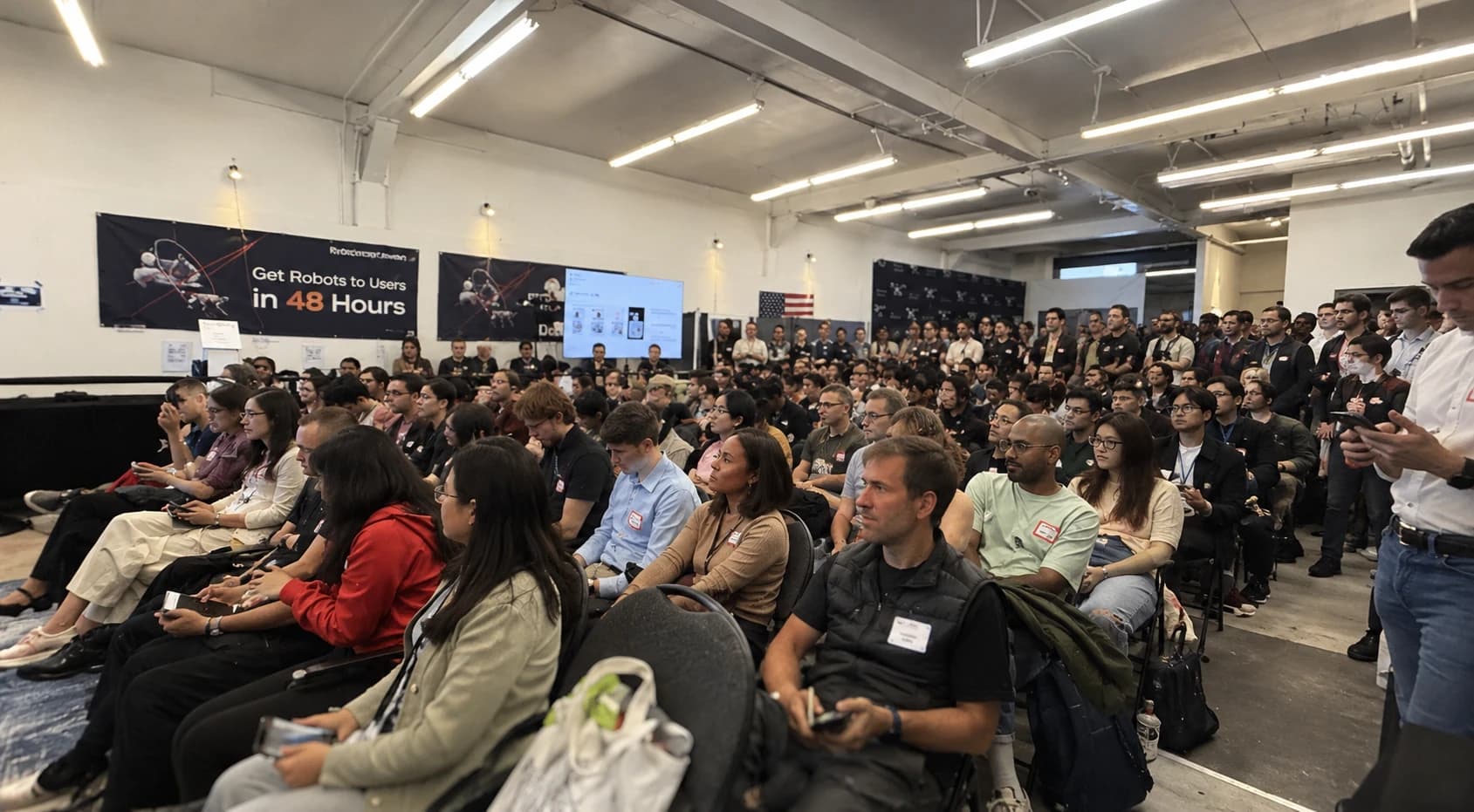
Our second flagship, featured in SF Tech Week and hosted at Robotics Center of Silicon Valley, brought together founders, data providers, researchers, investors and operators.
The panel worked through the questions every robotics team is budgeting around: which data actually improves a policy, what the unit of scale is for robot learning, how deployment changes what you collect next, and what a data provider has to deliver before a robot company writes a check.
What we covered
- 01Teleoperation, UMI, egocentric, exocentric and synthetic data
- 02What becomes the unit of scale for robot learning
- 03Deployment as a data engine
- 04What can become a third-party data market
Six takeaways
- 01The shortage is the right data, not more data. Task diversity and contact-rich interactions are closer to what models actually learn from than raw hours.
- 02Go deep before going broad. Depth on a few tasks wins until a policy works reliably; breadth pays off once the goal shifts to generalization.
- 03The cheapest data rarely transfers best. Teleop, handheld grippers, human video and simulation trade cost against fidelity.
- 04Deployment is the best data engine. Failures, interventions and edge cases from real fleets are free at the margin and exactly in-distribution.
- 05General models move the value, not remove it. Scarce value concentrates in action and contact data, plus real-world context no web dataset holds.
- 06Raw hours will commoditize; access will not. Durable moats are continuous access to real deployments, task coverage, and curation and evaluation.